PUBLIC TRAVEL DATA RESEARCH DESK · OPEN CC-BY 4.0 STUDIES
Research blog: airfare studies, trip budgets & weather briefs
Every post below pairs public government airfare, hurricane, safety, and coastal datasets with shareable charts and free calculators. Reporters, bloggers, and travelers may download high-resolution PNG charts or copy HTML embed snippets with a source link.
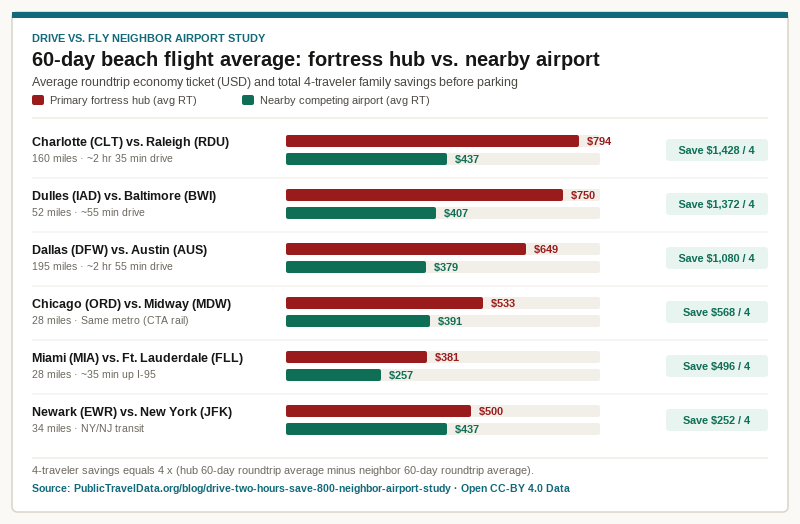
If you are booking Caribbean or Mexican beach flights for a family of four out of a high-markup hub, driving 45 to 165 minutes to a nearby competing airport saves $496 to $1,428. The widest gaps sit between Charlotte and Raleigh ($357 per ticket), Dulles and Baltimore ($343), and Dallas and Austin ($270).
Driving 45 to 165 minutes to a neighbor airport saves a family of four $1,428 in North Carolina (CLT vs RDU), $1,372 in DC-Maryland (IAD vs BWI), and $1,080 in Texas (DFW vs AUS) on international beach flights.
Shopping by flight deals alone backfires on weeklong beach trips: sub-$400 flights to Nassau ($391) and Bermuda ($336) land above $5,150 for two adults once resort rates are added, while Punta Cana ($4,225) and Roatan ($3,935) cost over $1,000 less overall.
50 years of NOAA HURDAT2 storm tracks show Bonaire, Curacao, Guanacaste, Aruba, and Grenada recorded 4 or fewer nearby hurricanes since 1976, offering calm August-to-October alternatives when northern Caribbean storm odds peak.
Flyers at single-airline hubs pay 35% to 65% more per mile for winter and spring break beach flights, led by CLT (29.8c/mi) and IAD (25.9c/mi), while BOS (-15.1%) and FLL (-14.3%) sit well below historical US DOT averages.