Drive 2 hours, save $1,000+: 6 US airport pairs where nearby gates beat major hubs
The short answer
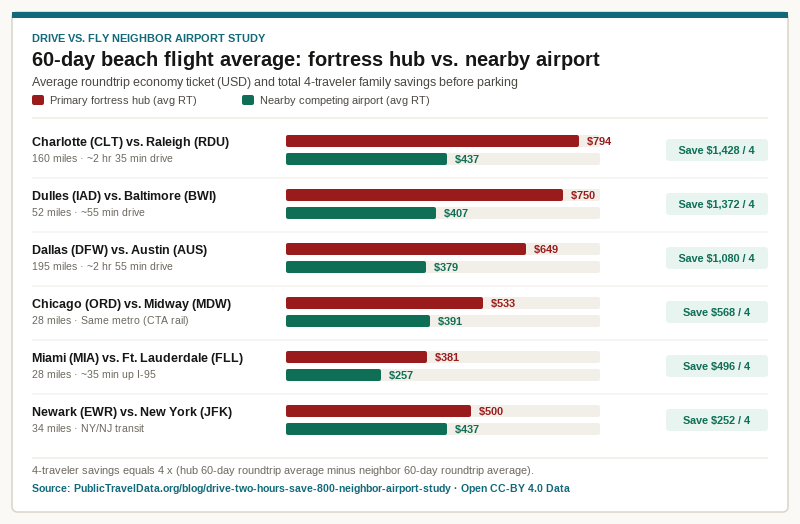
CC-BY 4.0 · Free to quote & embedIf you are booking Caribbean or Mexican beach flights for a family of four out of a high-markup hub, driving 45 to 165 minutes to a nearby competing airport saves $496 to $1,428. The widest gaps sit between Charlotte and Raleigh ($357 per ticket), Dulles and Baltimore ($343), and Dallas and Austin ($270).
Fast facts for travelers & reporters
Press desk: press@publictraveldata.org- Charlotte (CLT, $794 avg) vs. Raleigh-Durham (RDU, $437 avg): $357 saved per roundtrip ticket ($1,428 for four travelers) for a 160-mile drive up I-85.
- Washington Dulles (IAD, $750 avg) vs. Baltimore (BWI, $407 avg): $343 saved per ticket ($1,372 for four) for a 55-minute drive across the DC-Baltimore beltway.
- Even inside the same metro area, Chicago O'Hare vs. Midway saves $142 per ticket ($568 for four) and Miami vs. Fort Lauderdale saves $124 per ticket ($496 for four).
Why two nearby airports price the same beach $350 apart
Nobody loves waking up at 4 AM to drive down an interstate just to catch a flight. Yet if you fly out of CLT, IAD, or DFW, skipping that drive can cost your family an extra $1,000 before you even reach the beach.
Airlines price tickets around local gate competition, not highway distance. At single-airline hubs, the dominant carrier prices nonstop flights to Cancun, Montego Bay, Nassau, and Punta Cana for business travelers and loyal frequent flyers who will not switch airlines. One to two hours away, Southwest, JetBlue, and Spirit hold competing gates and force fares down by 25% to 45%.
Side-by-side math across all 6 US neighbor airport pairs
Download raw CSVDo the real net math before you commit: subtract roughly $60 for gas and $100 for a week of economy garage parking. Even after those road costs, five of the six pairs below still put $330 to $1,260 back in a family's pocket. Sort any column below or test your own airports in the live checker.
| Hub vs. neighbor | Drive distance | Hub 60d avg | Neighbor 60d avg | Saved / ticket | Saved (2 adults) | Saved (family of 4) |
|---|---|---|---|---|---|---|
| CLT vs. RDU (NC) | 160 mi | $794 | $437 | $357 | $714 | $1,428 |
| IAD vs. BWI (VA/MD) | 52 mi | $750 | $407 | $343 | $686 | $1,372 |
| DFW vs. AUS (TX) | 195 mi | $649 | $379 | $270 | $540 | $1,080 |
| ORD vs. MDW (IL) | 28 mi | $533 | $391 | $142 | $284 | $568 |
| MIA vs. FLL (FL) | 28 mi | $381 | $257 | $124 | $248 | $496 |
| EWR vs. JFK (NJ/NY) | 34 mi | $500 | $437 | $63 | $126 | $252 |
When paying the hub markup is actually worth it
Driving to a second airport is not always the right move. Be honest about the trade-offs before you book a cheaper seat two hours away:
- Skip the drive if you are flying solo. One ticket only captures one fare spread. Spending five hours roundtrip on the highway plus $100 in parking to save $120 or $140 rarely feels worth it on a Sunday night return.
- Watch out for lost nonstops to smaller islands. Big hubs like CLT and MIA run daily nonstop flights to Saint Lucia, Antigua, Grenada, and Saint Vincent. If a cheaper neighbor airport forces an extra layover with small kids, staying local can save half a vacation day.
- Factor in bags and seat assignments on budget carriers. Unbundled fares can add $90 to $130 per person for a checked bag and seat selection. On CLT-RDU or IAD-BWI, the $340+ spread still wins easily; on EWR-JFK ($63 spread), bag fees can erase the savings.
Common questions about this data
How much should I subtract for gas and parking before deciding to drive?
Budget roughly $120 to $160 total for a 7-night drive-and-park trip using off-airport covered parking ($8 to $14 a day) plus highway fuel. When two or more people fly out of RDU, BWI, MDW, or FLL instead of their pricier neighbor, ticket savings beat road costs comfortably.
Do extra bag fees on Southwest, JetBlue, or Spirit wipe out the savings?
Even if every traveler checks a bag at $110 roundtrip, RDU and BWI still beat CLT and IAD by more than $230 per ticket. The closer pairs like EWR vs. JFK ($63 gap) are where extra fees can wipe out the advantage.
More studies from the Research Blog
All studies ->Why a $350 flight alert often ends in a $5,200 beach week
Shopping by flight deals alone backfires on weeklong beach trips: sub-$400 flights to Nassau ($391) and Bermuda ($336) land above $5,150 for two adults once resort rates are added, while Punta Cana ($4,225) and Roatan ($3,935) cost over $1,000 less overall.
50 years of NOAA hurricane tracks & Level 2 advisories: what the data shows for fall trips
50 years of NOAA HURDAT2 storm tracks show Bonaire, Curacao, Guanacaste, Aruba, and Grenada recorded 4 or fewer nearby hurricanes since 1976, offering calm August-to-October alternatives when northern Caribbean storm odds peak.
Why flying from a one-airline hub adds up to $350 to your winter beach ticket
Flyers at single-airline hubs pay 35% to 65% more per mile for winter and spring break beach flights, led by CLT (29.8c/mi) and IAD (25.9c/mi), while BOS (-15.1%) and FLL (-14.3%) sit well below historical US DOT averages.
Methodology, federal sources & open reuse
Full methodologyData provenance: Every figure in this study comes from our public datasets combining US Department of Transportation (`T-100` and `DB1B`) airfare baselines, published island resort rate medians, 10-year NASA Langley POWER daily climate records, 50-year NOAA National Hurricane Center HURDAT2 storm tracks, and daily US State Department consular notices.
Zero commercial bias: Public Travel Data carries no display ads, airline sponsorships, or booking commissions. Download all underlying CSV spreadsheets on our Open data page.